About My Guitars
Every guitar I build is made from carefully selected woods, ensuring excellent acoustic resonance, structural stability, and natural beauty. While I certainly use and love the classic Spruce top/Rosewood or Mahogany back and sides, I also enjoy building with countless other beautiful sounding and looking woods from all over the world – many of which have been used to build amazing instruments for centuries. A primary goal I have when building a guitar is to showcase the beauty of the wood, and one of the ways that I achieve that is through primarily using hand tools and prioritizing quality workmanship rather than speed.
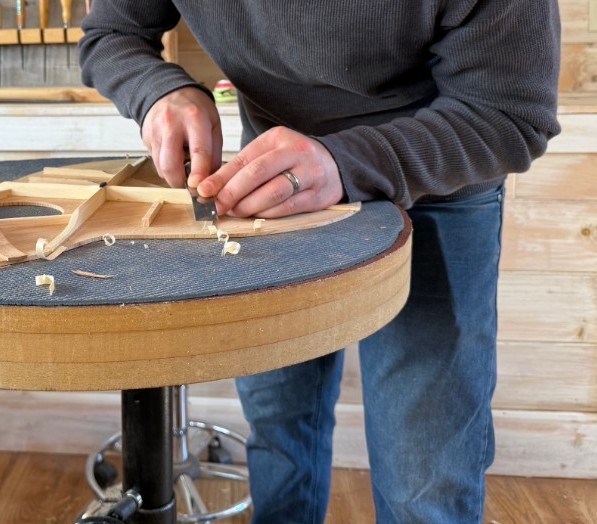
Voicing the tops and backs of my guitars is one of my absolute favorite aspects of building, as it plays a crucial role in creating an instrument that truly resonates and comes to life it’s when played. I meticulously choose the wood, gradually arrive at my desired thickness, and utilize bracing materials from several species of high-quality quartersawn spruce and cedar. Each guitar’s top and back are selected, thicknessed, and tap-tuned to ensure they work harmoniously together, and I design, scallop, and/or taper the bracing until I reach optimal resonance, balance, and overall musicality.
Some of the key elements of a guitar that can truly make or break the instrument is the feel of the neck, the fretwork, and the quality of the setup. If the neck is poorly shaped, the frets are uneven, or the nut/saddle are not made properly, an otherwise nice guitar will sound bad and be difficult to play. When I build a guitar, I spend a significant amount of time focusing on and really dialing in these often neglected areas of a guitar. An important consideration is that within these areas, preference and subjectivity play a major role -a huge benefit of a custom built guitar is that everything from neck shape, to wood choices, to the final setup is tailored to your personal preferences. I truly hope you get the chance to experience the difference between a custom hand-built instrument versus an off-the-shelf factory guitar.
About Me
One of my earliest childhood memories is my father singing me a song to fall asleep – “Uncle John’s Band”, by the Grateful Dead. Not only was this very likely when I became a lifelong Deadhead, but also when I realized how important and integral music is to my existence. By the time I was 18 years old, guitar playing was a full-blown obsession. In addition to studying psychology and clinical social work (I eventually became and still am a therapist), I also earned a degree in classical guitar performance and also one in music therapy.
I started to gig pretty regularly when I was about 20 years old, and during this time I became infatuated with the ambiguous and amorphous pursuit of chasing tone, as well as chasing the perfect setup on a guitar. Around this time I was having difficulty being able to afford or even find people who could do a good job working on my instruments. As a result of interest, necessity, and sometimes a lot of frustration, I learned how to maintain, repair, and modify my instruments, and eventually I began working on other people’s instruments too.
I remember when I first played a really nice hand-built guitar; long story short, not only did I buy that guitar, but that also initiated my guitar building journey. I had long enjoyed working with wood – from building furniture, to the deck in my back yard, to my elaborate electric guitar pedal board, it has always been enjoyable and something I felt naturally drawn toward. I soon began building my first guitar, and found my self sneaking away from my day-job to come home to and work on this instrument. As the saying goes, I “got bit by the guitar building bug”, and there was no turning back! To my surprise, although that first guitar was certainly not perfect, it sounded quite good and was a joy play. It also felt like some kind of magic to take raw pieces of wood – something that was once living and breathing – and to be able to turn that into an instrument. I began buying all the books I could find, taking guitar building courses, going to workshops, and connecting with seasoned luthiers to learn as much as I can about as much as I can. As I continued to build, to my delight, people not only liked my instruments, but they were eager to buy them. Fast forward – while I still do some therapy and teach/supervise emerging therapists, I am spending most of my time building and working on guitars, and I couldn’t be happier about it!